


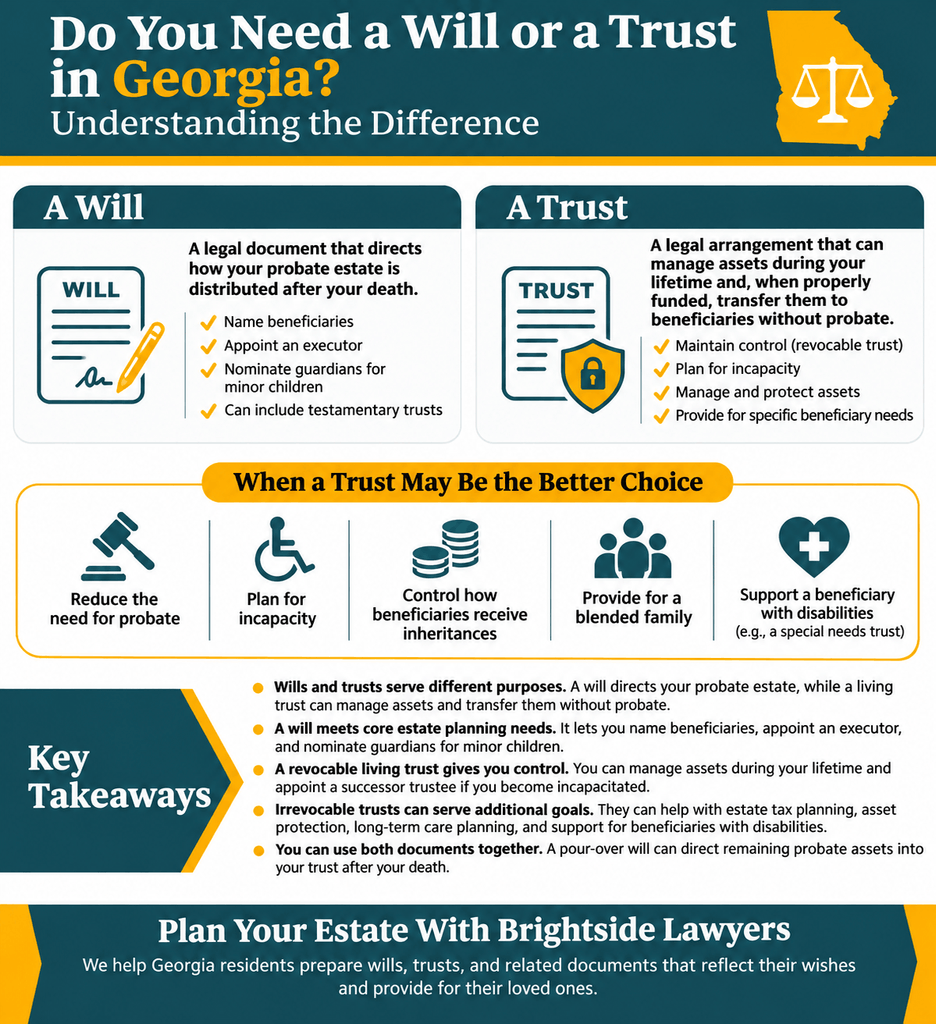
Key Takeaways
- Wills and trusts serve different purposes in Georgia estate planning. A will directs the distribution of your probate estate after death, while a living trust can manage assets during your lifetime and transfer them without probate.
- A will allows you to name beneficiaries, appoint an executor, and nominate guardians for minor children. Georgia requires a written will signed by the testator and witnessed by at least two competent individuals.
- A revocable living trust lets you retain control of your assets. You can appoint a successor trustee to manage trust property during incapacity and distribute it after your death, outside of the probate process.
- Irrevocable trusts can serve additional estate planning goals. Depending on their terms, they can support estate tax planning, asset protection, long-term care planning, and beneficiaries with disabilities.
- Using both a will and a trust can address different family and property needs. A pour-over will can direct remaining probate assets into an existing trust after your death, acting as a safety net for any assets not contributed to the trust during life.
- Brightside helps Georgia residents prepare wills, trusts, and related estate planning documents to meet your goals and needs. Our attorneys can help you choose arrangements that reflect your wishes and provide for your loved ones.
Deciding how to leave your property to loved ones is an important part of estate planning. In Georgia, two of the most common options are wills and trusts. While both instruments let you direct how your estate will eventually be handled, they do so in different ways: a will specifies how your probate estate is distributed after your death, while a living trust can manage assets during your lifetime and, when properly funded, transfer them to beneficiaries without the need of the probate court’s involvement.
At Brightside, we help Georgia residents create estate plans that reflect their wishes and preserve their legacy. Depending on your situation, you may need a will to nominate guardians for your minor children, a trust to manage your assets after death, or both documents to meet your needs.
What Does a Will Cover?
A last will and testament establishes how you want your probate assets distributed after you pass. It allows you to name beneficiaries, choose an executor to administer your estate, and provide instructions for distributing your property according to your wishes. You may use a will to nominate a guardian for your minor children and establish testamentary trusts to manage their inheritances.
Your will takes effect when you die. Your executor receives formal authority to administer your estate after the will is admitted to probate and the executor completes the court’s appointment requirements. While a will governs probate assets, property held in a trust, jointly with survivorship rights, and accounts with valid beneficiary designations pass outside of your will and outside of the probate process.
What Makes a Will Legally Valid in Georgia?
Under O.C.G.A. §§ 53-4-10 through 53-4-20, to execute a legally valid will, you must be at least 14 years old and have testamentary capacity, meaning a definite and rational intention about how your property should be distributed after your death. Other criteria are as follows:
- Your will must be in writing. An oral declaration or unwitnessed handwritten document doesn’t satisfy Georgia’s execution requirements.
- You must sign the will yourself or direct another person to sign it in your presence.
- At least two competent witnesses, each aged 14 or older, must sign the will in your presence.
- You must create the will freely, without coercion, fraud, or undue influence.
Georgia doesn’t require notarization for a will to be valid. However, under O.C.G.A. § 53-4-24, you can attach a notarized self-proving affidavit signed by you and your witnesses. This lets the probate court admit your will without needing testimony from the witnesses to establish its execution.
When is a Will a Good Fit in Georgia?
A will may be the right choice if you want to direct how your probate assets are distributed after your death without establishing a trust. It allows you to name beneficiaries, appoint an executor, and provide instructions for administering your estate. If any of the following situations apply to you, a will may be the right choice:
- You Have a Straightforward Estate: If you own a home, maintain bank accounts, and want to leave your property to a spouse or adult children, a will may meet your needs. You can identify who should inherit your probate assets and appoint an executor to carry out your instructions through the probate process.
- You Have Minor Children: You can nominate a testamentary guardian for your minor children in your will. If your child has no surviving parent, the probate court can appoint your nominated guardian after admitting your will to probate. You can also establish a testamentary trust in your will to manage property inherited by your children.
- You Want to Choose an Executor and Name Your Beneficiaries: A will allows you to select the person responsible for administering your probate estate. You can also identify the people or organizations you want to inherit your property and determine what each beneficiary should receive.
What Is a Trust and What Does It Cover?
A trust is a legal arrangement that allows you to place assets under the management of a trustee for the benefit of designated beneficiaries. Unlike a will, which takes effect after your passing, a living trust operates during your lifetime. It can also establish how your assets will be managed and distributed afterwards, generally without the need of the probate court’s involvement.
A trust involves three principal parties:
- Settlor (or Grantor): The person who creates the trust and transfers property into it.
- Trustee: The person or institution responsible for managing trust assets according to the trust’s terms.
- Beneficiary: The person or organization entitled to receive income, property, or other benefits from the trust.
Revocable Living Trusts
A revocable living trust lets you maintain control over assets transferred into the trust during your lifetime. You may serve as trustee, manage investments, buy and sell trust property, and receive income according to the trust’s terms. You may also change its provisions or revoke it if you’ve expressly reserved those rights.
Note: Under O.C.G.A. § 53-12-40, a Georgia trust must expressly reserve the settlor’s right to modify or revoke it. Any modification or revocation must also be in writing and signed by the settlor.
When you pass, your successor trustee can distribute trust assets according to your instructions, without having to go through the probate process. However, similar to a will, a revocable living trust doesn’t protect your assets from creditors during your lifetime or eliminate estate taxes: those protections may be found in an irrevocable trust.
Irrevocable Trusts
An irrevocable trust limits your ability to change or revoke its terms after it’s established. Georgia law permits court-approved modification or termination in certain circumstances. The requirements for consent, notice, and court approval depend on the legal basis for the requested change.
Irrevocable trusts serve several estate planning purposes, including:
- Estate Tax Planning: Certain irrevocable trusts can remove qualifying assets from your taxable estate when federal tax requirements are satisfied.
- Asset Protection: Properly established trusts can protect certain assets from beneficiaries’ creditors, subject to applicable legal restrictions.
- Long-Term Care Planning: Certain irrevocable trusts can play a role in Medicaid planning, subject to eligibility rules and transfer restrictions.
- Special Needs Planning: Qualifying trusts can provide resources for beneficiaries with disabilities while preserving eligibility for certain government assistance programs.
What Makes a Trust Legally Valid in Georgia?
Under O.C.G.A. § 53-12-20, an express trust must be established in writing and signed by the settlor or an authorized agent.
The trust must also have the following elements:
- Intent: The settlor must intend to create a trust.
- Trust Property: There must be identifiable property held under the trust.
- Beneficiaries: The trust must identify its beneficiaries or establish how they’ll be selected. Charitable trusts and trusts for the care of animals are exempt from this requirement.
- Trustee: A person or institution must be designated to administer the trust.
- Trustee Duties: The trustee must have responsibilities for managing trust property, such as safeguarding assets, keeping financial records, making distributions to beneficiaries, and following the trust’s instructions.
Creating a trust is only part of the overall planning. You must also transfer the intended assets into it through the appropriate ownership or title changes. At Brightside, we help you establish trusts that reflect your intentions for your estate and its beneficiaries.
When Might a Trust Be the Better Choice in Georgia?
A trust may be the better choice if you want to manage your assets during your lifetime, plan for incapacity, or reduce the need for probate. Trusts may also help you control how your beneficiaries receive their inheritances, provide for blended families, or support beneficiaries who need ongoing financial assistance.
- You Want to Reduce the Need for Probate: When you transfer assets into a revocable living trust, those assets can pass to your beneficiaries without probate after your death. If you own real estate in multiple states, transferring those properties into the trust can help your family avoid separate probate proceedings in each state.
- You Want to Plan for Incapacity: A revocable living trust allows you to appoint a successor trustee who can manage property held in the trust if you become incapacitated. The trust document establishes how incapacity is determined and when the successor trustee receives authority.
- You Want Greater Control Over Your Beneficiaries’ Inheritances: A trust allows you to establish when beneficiaries receive their inheritances and how the funds can be used. Instead of distributing property outright, you can direct the trustee to manage assets until beneficiaries reach designated ages or meet conditions you’ve established.
- You Have a Blended Family: If you have children from a previous marriage, a trust can help you provide for your current spouse while preserving an inheritance for your children. You can establish instructions that allow your spouse to receive income or other benefits from trust property during their lifetime, with remaining assets passing to your children after your spouse dies.
- You Have a Beneficiary With Disabilities: A special needs trust can provide financial assistance to a beneficiary with disabilities while protecting eligibility for certain means-tested government benefits, including Supplemental Security Income and Medicaid. The trustee manages trust assets and makes distributions in accordance with the requirements governing those benefits.
Will vs. Trust in Georgia: Key Differences
A will and a revocable living trust both allow you to decide who will inherit your property, but as you’ve seen, they operate differently. The following table compares their principal features.
| Feature | Will | Revocable Living Trust |
| When It Takes Effect | After your death | During your lifetime |
| Probate | Probate is typically required to administer assets governed by the will | Assets properly transferred into the trust can pass without probate |
| Privacy | A probated will becomes part of the public court record | Trust terms ordinarily remain private unless disclosure is required |
| Incapacity Planning | Doesn’t authorize anyone to manage your property during your lifetime | A successor trustee can manage trust assets if you become incapacitated |
| Guardianship | Can nominate a guardian for minor children | Doesn’t appoint a guardian for minor children |
| Asset Distribution | Directs the distribution of your probate estate and can create testamentary trusts | Can retain and distribute trust property over time, either outright or in further trust |
| Changes | Can be amended or revoked while you have testamentary capacity, following Georgia’s execution requirements | Can be amended or revoked if you’ve reserved those rights |
| Initial Expenses | Usually costs less to prepare up front, but will likely require future costs for probate administration | Usually requires higher initial legal fees and property transfers into the trust |
| Administration | An executor administers the probate estate | A trustee manages trust property according to its terms |
Speak to a Georgia Wills and Trusts Attorney
Choosing between a will and a trust depends on your property, family responsibilities, plans for distributing your assets, and level of comfort in the probate process. A will allows you to name beneficiaries, appoint an executor, and nominate guardians for minor children. A living trust, on the other hand, can provide for asset management during incapacity and reduce the need for probate. Using both documents may be the right approach for your family.
At Brightside, we help Georgia residents create estate plans that protect their interests and reflect their wishes. We’ll review your assets, discuss your goals, and help you prepare wills, trusts, and related documents that work together. To schedule an initial consultation and take the next step toward securing your family’s future, call 404-492-9559 or fill out our online contact form.
FAQs About Wills and Trusts in Georgia
Does Having a Will Mean My Estate Must Go Through Probate?
If your executor needs court authority to administer assets governed by your will, the document must be admitted to probate. Georgia recognizes two methods for probating a will:
- Common Form Probate: Under O.C.G.A. § 53-5-17, a will can be admitted to probate without advance notice to heirs or beneficiaries. One subscribing witness can establish the will’s execution, although testimony isn’t necessary when the will has a valid self-proving affidavit. Interested parties retain the right to challenge common form probate, which becomes conclusive four years after the court enters its order.
- Solemn Form Probate: Under O.C.G.A. § 53-5-21, the probate court requires notice to the deceased person’s heirs before admitting the will. Interested parties have an opportunity to contest its validity. Once the court enters a final order, the determination is binding, subject to any rights of appeal.
Both methods allow the court to appoint an executor and issue letters testamentary. These documents establish the executor’s authority to administer the estate.
How Can a Living Trust Help You Avoid Probate?
A revocable living trust allows your successor trustee to manage and distribute trust property after your death without obtaining probate court authorization first. This can reduce court involvement and allow your beneficiaries to receive property according to the instructions you’ve established, potentially sooner than under the probate process.
For example, if you transfer your Georgia home into a revocable living trust, your successor trustee can manage or distribute that property after you pass without probating the home through your estate. But creating a trust doesn’t eliminate probate for property you leave outside it. If you establish a trust but never transfer ownership of your home or other intended assets, those assets may still need to be probated. Therefore, to ensure your assets avoid probate, after establishing a trust, it’s important to transfer intended assets into the trust.
What Is a Pour-Over Will?
A pour-over will directs property remaining in your probate estate into an existing trust after your death. It essentially serves as a safety net for assets you haven’t transferred into the trust during your lifetime.
For example, suppose you establish a revocable living trust and transfer your home and investment accounts into it. Several years later, you purchase another property but die before transferring its title to the trust. A pour-over will can direct your executor to transfer that property into the trust after completing the required probate administration. Ultimately, the trust will distribute the property to your beneficiaries, as contemplated by the terms of the trust.
Under O.C.G.A. § 53-12-101, you can leave property to a trust identified in the will. The trust’s terms must appear in a separate written trust instrument executed before or at the same time as the will, or in the valid will of someone who died before the testator.